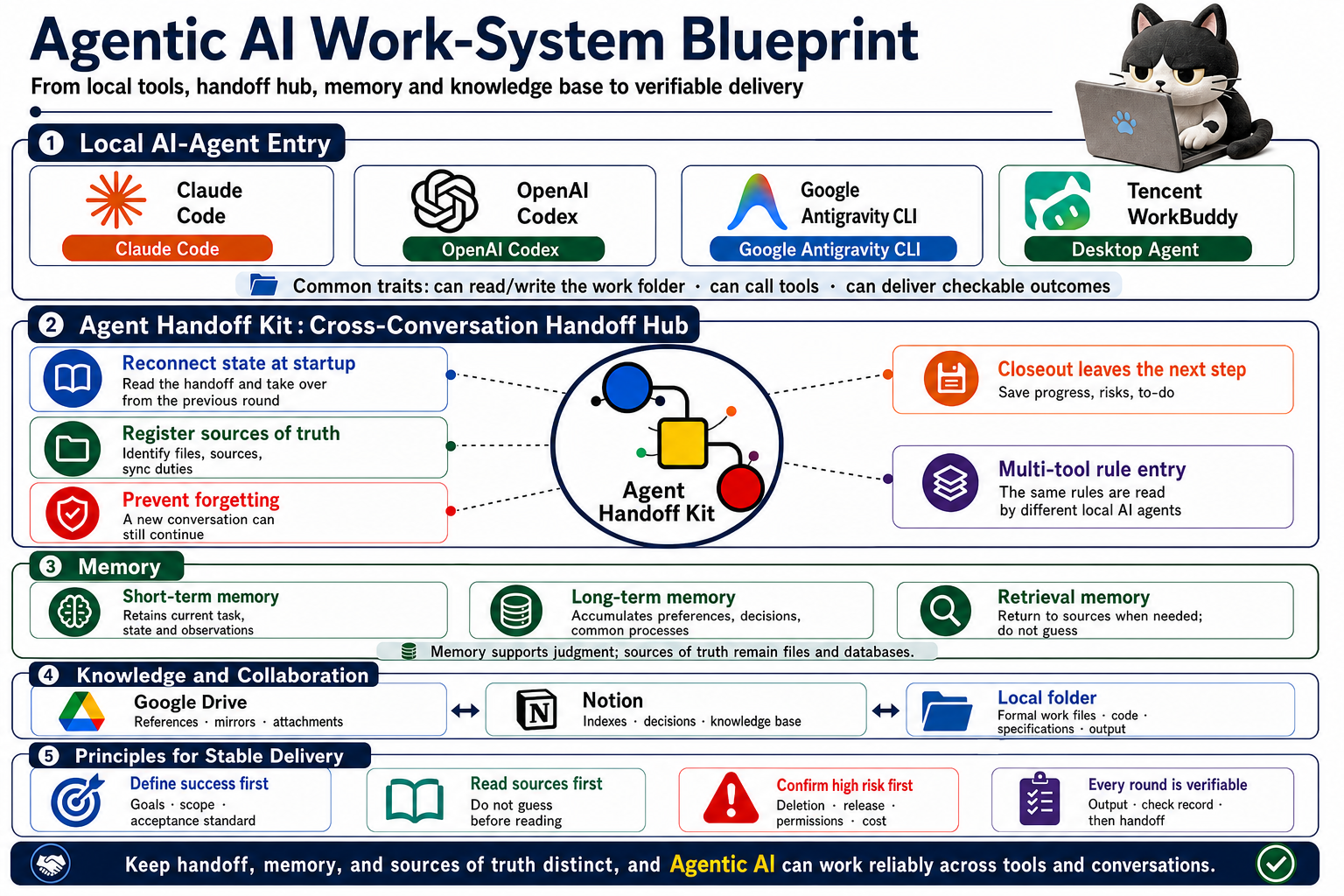
Connector, plugin, skill, and MCP are tool-access layers, not the core product definition.
Local AI agents usually need tool access, data connections, and reusable methods. A connector connects external services. A plugin brings in a capability set. A skill saves reusable practice. MCP provides a standard interface for AI tool/resource usage. They are important, but they are not Agent Handoff Kit’s product identity.
My division is this: tools enable actions, governance enables stable actions, and Agent Handoff Kit keeps state, source-of-truth, rules, safety boundaries, and next-start guidance in project files.
So those elements belong to a tool and permission layer: what can be read, what tools can run, what needs confirmation, and what results must be written back to source-of-truth. Do not merge external tools, memory, sync, and handoff into one simply because AI can call tools.
Make each task a loop
I treat one AI task as a loop: define scope, read source-of-truth, act with tools, inspect outcomes, accept, then hand over next steps. That is loop engineering: not requiring a one-shot perfect answer but creating a system that supports repeated observation, correction, and acceptance.
Current harness-oriented thinking follows the same direction: do not look only at model quality. Look at how model, tools, permissions, memory, observation, failure attribution, human intervention, and acceptance combine in a working system. For individuals, you do not need a big platform first; a clean folder setup, source-of-truth registry, tool permissions, handoff, acceptance criteria, and high-risk confirmation are enough.
Acceptance should be multidimensional
Smooth text does not equal completion. Before formal delivery, I check target fit, source-of-truth reads, file and link presence, visual usability, and high-risk confirmation. The next step is not a delivery detail alone; it is the continuity information that must remain at closeout.
This is not a corporate slogan. It is day-to-day operational scope: what AI can read, what AI can modify, what AI can call, when it must stop, how acceptance is done, and how state is handed to the next session.